Posts

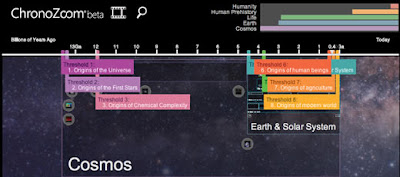
ChronoZoom - wow!

Image
ChronoZoom combines thinking from many of our content areas. It is a Web site as application, a new form of digital story telling, a history of everything timeline, a cross linking of the humanities and sciences and currently the first stage of a global community composition project. It is not completed, but it is far enough along that the project is seeking feedback: http://www.chronozoomproject.org / It is a classic example of the power of melding different elements in the digital palette , so far including: text, 2D animation, images from photos to complex layered almost infinitely zoomable graphics, audio, video, programming and different levels of interactivity. Here's a short news clip that gives a quick overview of its major concepts, http://arstechnica.com/science/news/2012/03/chronozoom-takes-you-through-14-billion-years-of-space-time-via-html.ars?clicked=related_right Alvarez is a character of international renown in science and how he served as catayst for this project ...
Latitude & Longitude & on to GPS

One of the foundations for reading and understanding maps and finding your way in the real world are the concepts of latitude and longitude. Their lines and numbers are used within Google Earth and GPS systems. Explore the multimedia article also titled Latitude & Longitude & on to GPS . Use the comments field below to contribute your thoughts on this piece. Please also contribute ideas, Web addresses and other related resources that can extend and improve it.

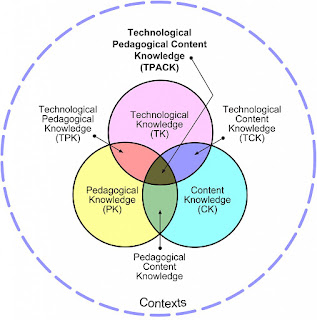
TPACKs insufficient transitional model

Image
The currently popular TPACK model separates technology knowledge from pedagogy and content, viewing technology as a set of basic operational skills with a thing or things. This might be useful if it will be seen as the insufficient perspective that it provides. It is the equivalent to saying that writing is the basic operational skill with pencils, pens, books and paper, with skill in using and safely storing and organizing the data put on them, with skill in installing and removing books and articles and switching out procedures for different writing sequences and using the postal service. Yes, we needed to know those things to think with text for the last several centuries, and we need to know basic digital skills for the 21st century but this perspective loses sight of the forest for the trees. TPACK is a transitional digital immigrant perspective forced on education by its low socio-economic status in our culture. Education’s SES has long prevented digital technologies from be...

Freedom Box

Image
It's hard to see freedom and its ally of privacy disappearing, until they're gone. Nice software project underway to get it back using off the shelf hardware. To play the CBS News story, click the next link: http://www.cbsnews.com/video/watch/?id=7358702n http://www.sdtimes.com/blog/post/2011/08/24/Taking-Control-of-User-Data.aspx http://freedomboxfoundation.org/ Original outing of the idea, 57 minute lecture, http://www.law.columbia.edu/magazine/interactive/5848/view-more-professor-eben-moglens-2010-internet-society-speech

The knowledge society: How can teachers surf its data tsunamis?

Image
Properly sifted and mixed, data becomes knowledge and occasionally wisdom. The ongoing explosion of information, represented by the graph on the left, has challenged our cultural capacity in the extreme. Your comments and reactions to a much larger article, The Knowledge Society , are encouraged.

Info Age Against Industrial-Military Complex

The revolutionary struggles in the Middle East, facilitated by the social networking tools of the Web, are one more sign of the titanic struggle between the growing power of Net collaborating and the heterarchical nature of the information versus the Web and the centralized power of the hierarchical forces that President Dwight D. Eisenhower (also commander in-chief of the free-world military in WWII) saw and warned about in his closing address to the nation in 1960 in regard to the industrial-military complex (and in his 1953 Chance for Peace speech). In the United States the next election might be defined as information systems vs. money and weapons systems, the Web vs Wall Street.

Exponential Gaps

Visit msnbc.com for breaking news , world news , and news about the economy The rapid growth of information provides a constant source of change and new opportunity. Information management can be divided into 3 major divisions, each evolving at their own unique pace: storing information (reaching across time, 23% growth per year); communicating iniformation (reaching across space, 28% growth per year); and computing information (composing or processing, 58% growth per year) (Hilbert & Lopez, 2011). The impact of that growth is continually revealed in a number of cultural changes whose implications are still being analyzed. One sign of the information age transformation from 1950 to 1980 was that manufacturing goods had been eclipsed by information management as the dominant economic activity in the world. The tipping point in information storage occurred in 2002 when more information was stored digitally than in analog format. In 2000, 75% of the world's information was still i...