Posts

ranking uses of Twitter

Much as been made over the trivial nature of the tweets of many Twitterers. However, that critique could be leveled at much that is composed in many forms, not just Twitter.com on the Web. The greater challenge for Twitter is to build sufficient twiteracy to create useful and interesting roles for the application. So, let's push the envelope. What are the rank-ordered top ten problems or challenges that Twitter can address or even solve? I've parked a couple of ideas on this page, Twiteracy Top Ten in hopes of adding more. Comments that can be added to the page are welcomed!

finding info by Web Country codes

P.S. For those who Twitter, this post can also be found at http://tinyurl.com/dkwfp6 If you want to Google (search) for the perspective of someone from a different country or if you want to find someone with an email account, or media created by someone in a different country, then in the search string use site: followed by the country code. For example, if looking for a history professor in Germany then one might search "history professor" site:.DE and yes there is a period between the colon and the letters DE. Odds are that the history professor's Web pages are in German requiring you to know the German translation for history professor in order to do the search. Of course, knowing the country codes can be a challenge. So here's some country code solutions. I copied down the country code text from wikipedia and saved as text file from Word, then imported into Excel, then imported into Blist. The Blist database is titled Web Country Codes . Now anyone can search ...

Google's GeoEye hotshot imagery arriving

It has taken some time since he September launch of the GeoEye satellite, but the fine tuning is done and the images have been pouring in to the Google Earth database. The first fabulous samples can be found here: http://earth.google.com/geoeye/index.html Even more important is the new version of the app, Google Earth 5.0, which includes the multimedia options for making narrated movies of traveling across Google Earth to see the scenes from under the ocean to across all land masses.

Gapminder-data for the socially conscious

When the goal is to show the evidence, the tangible results of verifiable measurement, Gapminder provides the statistical power in a visually compelling way.

New satellite-Visual literacy with Google Earth

Image
Most real problems have a geographic factor. Google Earth is a superb application for educators and problem solvers, one that is constantly improving. One problem has been the display of fuzzy to high quality images from satellite images that might be up to several years old, depending on whether you were rural or in a fast growing high population area. The San Francisco bridge image on the left is an example of the high quality to which Google is soon switching (click image for larger photo) for all its images. The company GeoEye launches the GeoEye-1 on Sept 4, 2008, just days away. According to Google's Hurowitz, it "has the highest ground resolution color imagery available in the commercial marketplace and will produce high-quality imagery with a very accurate geolocation." At highest quality, a twenty-two inch (.41 meter) area in black and white or 1.65 meters in color will make up 1 pixel. In one click it can capture great quality of an area the size of the state...

New online digital literacy options

Image
The number and quality of the applications available on the Web continues to grow. In fact, applications that don't have an online equivalent are increasingly hard to find. Some of the most notable of these new Web 2.0 applications that I'm exploring add to the text tools of the digital literacy palette (on left). They include the database applications of  Blist (database with spreadsheet features) and LazyBase . Of further interest are the Spreadsheet applications within Google Docs, and  EditGrid . However, these are just some of the highlights of hundreds of Web 2.0 applications that are categorized on the Evoke-Problem Solving page .

The affordable "digital pencils"

Image
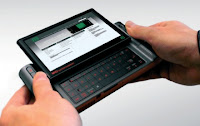
Thirty years after I first took my first personal computers from Commodore (the PET), Radio Shack (TRS-80) and Apple (the Apple II) into my elementary classrooms in Wisconsin, we are almost there, finally close to realizing the dream of a new public school curriculum built on the metaphorical digital pencil (e.g.,  affordable , networked, every child has one in the classroom, personal computer). For example of price movement in the right direction, see  EB's simple MIMD prototype  to the left or explore Gillette's excellent chart comparing the current leading  low cost laptop computers , which does not include the Elonex One  (100 UK), Northec Gecko  ($300 and up), or the more than 25 new Intel Atom processor devices ($250-$350)  coming soon. It took the recent threat of Nicholas Negroponte's $100 XO laptop vision for the computer industry to "get religion" on the topic of functional ubiquitous child-priced computers. The industry then shifted close to panic this...