Posts

New satellite-Visual literacy with Google Earth

Image
Most real problems have a geographic factor. Google Earth is a superb application for educators and problem solvers, one that is constantly improving. One problem has been the display of fuzzy to high quality images from satellite images that might be up to several years old, depending on whether you were rural or in a fast growing high population area. The San Francisco bridge image on the left is an example of the high quality to which Google is soon switching (click image for larger photo) for all its images. The company GeoEye launches the GeoEye-1 on Sept 4, 2008, just days away. According to Google's Hurowitz, it "has the highest ground resolution color imagery available in the commercial marketplace and will produce high-quality imagery with a very accurate geolocation." At highest quality, a twenty-two inch (.41 meter) area in black and white or 1.65 meters in color will make up 1 pixel. In one click it can capture great quality of an area the size of the state...

New online digital literacy options

Image
The number and quality of the applications available on the Web continues to grow. In fact, applications that don't have an online equivalent are increasingly hard to find. Some of the most notable of these new Web 2.0 applications that I'm exploring add to the text tools of the digital literacy palette (on left). They include the database applications of  Blist (database with spreadsheet features) and LazyBase . Of further interest are the Spreadsheet applications within Google Docs, and  EditGrid . However, these are just some of the highlights of hundreds of Web 2.0 applications that are categorized on the Evoke-Problem Solving page .

The affordable "digital pencils"

Image
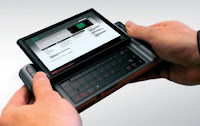
Thirty years after I first took my first personal computers from Commodore (the PET), Radio Shack (TRS-80) and Apple (the Apple II) into my elementary classrooms in Wisconsin, we are almost there, finally close to realizing the dream of a new public school curriculum built on the metaphorical digital pencil (e.g.,  affordable , networked, every child has one in the classroom, personal computer). For example of price movement in the right direction, see  EB's simple MIMD prototype  to the left or explore Gillette's excellent chart comparing the current leading  low cost laptop computers , which does not include the Elonex One  (100 UK), Northec Gecko  ($300 and up), or the more than 25 new Intel Atom processor devices ($250-$350)  coming soon. It took the recent threat of Nicholas Negroponte's $100 XO laptop vision for the computer industry to "get religion" on the topic of functional ubiquitous child-priced computers. The industry then shifted close to panic this...

21st Century Literacy

Image
If a quick definition of literacy is the capacity to both understand and create what goes on a page, then to determine current literacy needs we must be able to compare what happens on paper pages with what happens in 21st century communication on Web pages. Is the digital palette on the left a sufficient summary of the major forms of composition on the web? Of the elements on this palette, how are these Web forms being combined and integrated with the historical precedents of literacy? By what strategies will public education incorporate these forms into public school curriculum for all students? A more in-depth treatment of digital literacy is also available online.

Serious questions-LinkedIn

The social networking site for professionals, LinkedIn, provides a great question/answer service, LinkedIn Answers, http://www.linkedin.com/answers/ And like many such sites, LinkedIn provides permanent links to a question. This is a key feature for building a web page of questions and tracking responses generated by an individual or by a team.

Community Based Research (CBR)

The CBR Networking Initiative has created a wiki site with the goal of building an online handbook for those engaged in community based development and research, http://www.cbrwiki.org/.

Flatworld Processor

Image
Entrepreneurship Mashups Concept: given the host of web 2.0 composition tools and resources on the net, the potential exists to create entrepreneurship processors for composing a new business. Since the concept of " The World is Flat " is only marginally realized, aggregating mashups at higher levels accelerates the world's capacity to add value to its systems. Doing so makes the highway to flatworld more inclusive. The question is fairly straight forward. Given a set of steps or procedures for creating a new organization, whether business or non-profit, what web 2.0 etc. tools match each step? As there is no magic formula, there are many sequences that can work, just as there are many recipes for a good meal. Elegant recipes turn out great meals in the fewest possible steps. So, the challenge is on - to design and create a set of elegant processors for startups and beyond. Let's coin a phrase: The Flatworld Processor Define/describe and name the entrepr...